
Rigorous Methods.
Real-World Impact.
Science. Transparency. Independent Verification.
Wellness Indicators Moving in the Right Direction
- · Improved oxygen delivery
- · Improved recovery conditions
- · Improved physiological efficiency
- · Improved wellness indicators
Better oxygenation leads to faster recovery. Better recovery leads to stronger performance.
- · Reduced variability
- · Improved organisation
- · Improved coherence
- · Improved systemic balance
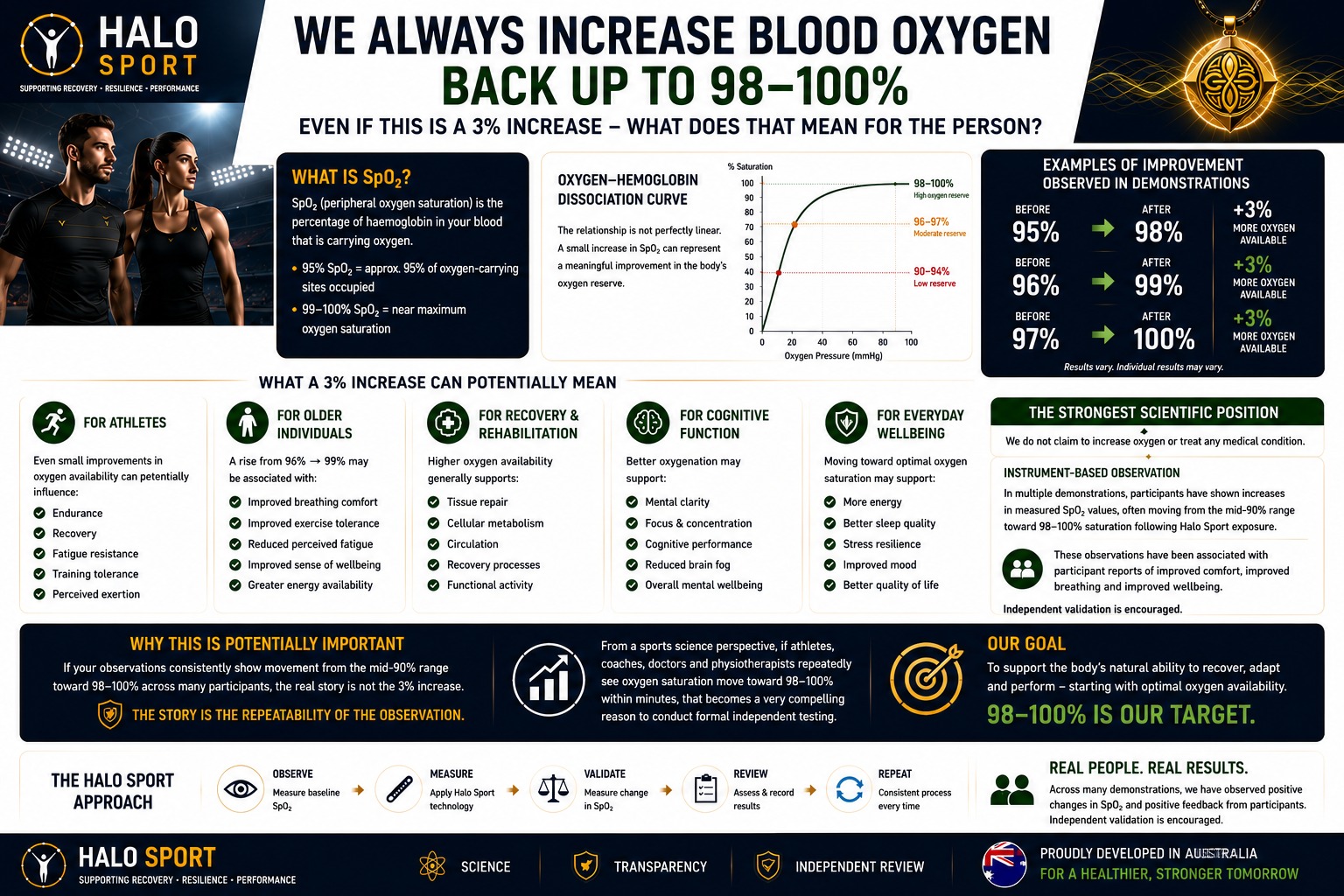
We Always Increase Blood Oxygen Back Up to 98–100%
Even if this is a 3% increase — what does that mean for the person?
SpO₂ (peripheral oxygen saturation) is the percentage of haemoglobin in your blood that is carrying oxygen.
- · 95% SpO₂ ≈ 95% of oxygen-carrying sites occupied
- · 99–100% SpO₂ = near maximum oxygen saturation
The relationship is not perfectly linear. A small increase in SpO₂ can represent a meaningful improvement in the body's oxygen reserve.
- 98–100% · High oxygen reserve
- 96–97% · Moderate reserve
- 90–94% · Low reserve
Results vary. Individual results may vary.
- ✓ Endurance
- ✓ Recovery
- ✓ Fatigue resistance
- ✓ Training tolerance
- ✓ Perceived exertion
- ✓ Improved breathing comfort
- ✓ Improved exercise tolerance
- ✓ Reduced perceived fatigue
- ✓ Improved sense of wellbeing
- ✓ Greater energy availability
- ✓ Tissue repair
- ✓ Cellular metabolism
- ✓ Circulation
- ✓ Recovery processes
- ✓ Functional activity
- ✓ Mental clarity
- ✓ Focus & concentration
- ✓ Cognitive performance
- ✓ Reduced brain fog
- ✓ Overall mental wellbeing
- ✓ More energy
- ✓ Better sleep quality
- ✓ Stress resilience
- ✓ Improved mood
- ✓ Better quality of life
If observations consistently show movement from the mid-90% range toward 98–100% across many participants, the real story is not the 3% increase.
The story is the repeatability of the observation.
To support the body's natural ability to recover, adapt and perform — starting with optimal oxygen availability.
98–100% is our target.
Measure baseline SpO₂
Apply Halo Sport technology
Measure change in SpO₂
Assess & record results
Consistent process every time
How We Prove It
Objective physiological and environmental data collected with calibrated instruments.
Controlled comparisons across paired conditions.
Repeated baseline conditions to confirm causality.
Third-party measurement and review encouraged.
Transparency drives trust.
Better methods. Better results.
One technology. Many environments.
Consistent results.
Improved stability and efficiency across vehicles and fleets.
Enhanced performance and reliability in marine environments.
Stabilised operations across complex industrial systems.
Improved recovery and performance outcomes for people.
Transparency · Integrity · Science · Results